
GHK-Cu vs AHK-Cu: How Skin and Hair Research Differ
Direct answer
GHK-Cu and AHK-Cu differ in their first amino acid, so each needs its own evidence record. The cited GHK-Cu work concerns collagen and connective tissue; the AHK-Cu study concerns follicles and dermal papilla cells. Select by research question, verify the ingredient, and test the actual formulation. Blue color cannot establish identity.
In this article
- 1. One amino-acid change is enough to require a separate evidence file
- 2. What the AHK-Cu hair study actually investigated
- 3. What the GHK-Cu collagen and wound studies add
- 4. Skin and hair projects need different acceptance endpoints
- 5. Blue color is a clue, not an identity certificate
- 6. Compatibility belongs to the full formulation
- 7. Ordering copper peptides for a real development program
- 8. The better copper peptide is the one matched to the question
1. One amino-acid change is enough to require a separate evidence file
GHK-Cu and AHK-Cu are both copper–tripeptide complexes, but they are not the same ingredient. GHK contains glycine, histidine, and lysine; AHK contains alanine, histidine, and lysine. That first-residue difference matters for identity and prevents the research literature from being transferred automatically between them.
The distinction is particularly useful in skin and hair research. A frequently cited hair-follicle study investigated AHK-Cu, not GHK-Cu. Foundational GHK-Cu papers investigated collagen synthesis in fibroblasts and connective-tissue accumulation in a rat wound model.[1][2][3] All three sources are relevant to copper-peptide research, but they answer different questions about different materials.
For a formulator, the practical risk is straightforward. An article may cite an AHK-Cu hair result while a purchasing spreadsheet lists GHK-Cu. A blue solution and a familiar “copper peptide” label can make the mismatch easy to overlook. The project then starts with a different ingredient from the one described in the supporting paper.
From the study to the sample request
Identify the peptide tested and the endpoint measured before using a study to support a sample request. Then assess the proposed formulation separately. Cell and follicle findings can help select an ingredient, but they do not establish how every serum containing it will perform. The finished product needs its own evaluation.
GHK-Cu and AHK-Cu are related copper complexes, not interchangeable names. Match the peptide sequence to the source paper before assigning a skin or hair claim to a product.
This gives LaviPep buyers a more useful starting point than asking which copper peptide is “best.” A skin-matrix project and a hair-follicle project may require different evidence, models, and formulations. The correct first sample is the one that matches the project’s actual question.
The three primary studies below provide the starting evidence for that decision. Reading their models and endpoints together helps a buyer distinguish a hair-focused ingredient evaluation from work on skin matrix and connective tissue.
2. What the AHK-Cu hair study actually investigated
The 2007 study evaluated L-alanyl-L-histidyl-L-lysine–Cu2+, or AHK-Cu, in human hair follicles ex vivo and cultured dermal papilla cells in vitro. It reported stimulation of follicle elongation and dermal papilla cell proliferation under the tested conditions.[1] The use of human-derived tissue is important, but ex-vivo tissue is not the same evidence category as a clinical trial of a finished scalp product.
The study also examined apoptosis-related measurements. Some molecular markers changed in a direction consistent with the authors’ proposed mechanism. However, the reported decrease in the number of apoptotic dermal papilla cells was not statistically significant.[1] Retain the cell-count finding alongside the molecular markers when describing the proposed anti-apoptosis mechanism.
Three levels of observation
- Follicle: Elongation was measured in the ex-vivo model.
- Cell population: Proliferation was examined in cultured dermal papilla cells.
- Mechanistic markers: Apoptosis-related proteins and cell-labeling results added context.
These levels complement one another, but none should be renamed as a guaranteed increase in hair density on a person’s scalp. A clinical hair endpoint might involve density, shaft diameter, shedding, or standardized photography over time. Those outcomes require a different study design from the one described here.
The concentration range in the paper is also an experimental condition, not a finished-serum recipe. An ingredient placed into a complex formulation may have different availability, stability, and interaction with other constituents. A formulator should not copy a cell-culture concentration directly into a commercial product without a formulation and evaluation plan.
AHK-Cu is a material to consider when a hair-focused project builds on this human follicle and dermal papilla evidence. Use the experimental results to choose a follow-up endpoint, then test the proposed formulation. The evidence remains specific to AHK-Cu; it does not establish the same findings for GHK-Cu or the performance of a finished product.
3. What the GHK-Cu collagen and wound studies add
The 1988 fibroblast paper investigated GHK-Cu and reported stimulation of collagen synthesis over a defined concentration range. Importantly, the reported stimulation was independent of a change in cell number.[2] This means the finding should not be summarized merely as “more fibroblasts.” The measurement concerned collagen synthesis in that culture system.
The 1993 study extended the investigation into a rat wound-chamber model. The researchers measured material accumulated within implanted chambers, including collagen, total protein, DNA, and glycosaminoglycans. They reported concentration-dependent changes in several extracellular-matrix-related measurements.[3] This is tissue-repair research, not a clinical wrinkle trial of a cosmetic cream.
Swipe or scroll to compare all columns.
| Primary source | Ingredient | Model and endpoint | Useful conclusion |
|---|---|---|---|
| Pyo and colleagues, 2007 [1] | AHK-Cu | Human follicles ex vivo and dermal papilla cells | Hair-focused experimental evidence for AHK-Cu |
| Maquart and colleagues, 1988 [2] | GHK-Cu | Fibroblast collagen synthesis | Matrix-related cellular evidence for GHK-Cu |
| Maquart and colleagues, 1993 [3] | GHK-Cu | Rat wound-chamber extracellular-matrix measurements | In-vivo preclinical connective-tissue evidence |
Why this is not a winner-versus-loser comparison
The studies were not designed as a direct GHK-Cu-versus-AHK-Cu contest using one shared endpoint. They show different research emphases. A hair-focused formulator may find the AHK-Cu follicle study particularly relevant, while a matrix-focused project may begin with the GHK-Cu work. A direct ingredient comparison remains a separate experiment.
The distinction also keeps marketing language traceable. If a product brief discusses GHK-Cu, its footnote should support GHK-Cu. If it cites an AHK-Cu result for context, the text should name AHK-Cu and explain why it is being discussed. Name the tested molecule in the claim itself so that its relationship to the cited paper is visible before the reader opens the source.
Ingredient-specific studies can guide a formulation project. They do not establish equivalent performance between different copper peptides or between every finished product containing them.
4. Skin and hair projects need different acceptance endpoints
A skin-formulation project may investigate matrix-related markers, barrier-relevant properties, appearance, or tolerability. A hair project may investigate follicle behavior, dermal papilla responses, or finished-product outcomes over time. Those endpoints are not interchangeable, even when the same ingredient category appears in both discussions.
The first design decision is therefore the intended claim or research question. “Copper peptide performance” is too broad to determine whether a particular assay is useful. A more specific question might ask whether an ingredient remains chemically stable in a proposed vehicle, or whether a defined preparation changes a particular cell or follicle endpoint under controlled conditions.
Swipe or scroll to compare all columns.
| Project | Evidence that helps start it | Additional work needed |
|---|---|---|
| GHK-Cu matrix research | Fibroblast and rat wound studies | A model matched to the new hypothesis |
| AHK-Cu hair research | Follicle and dermal papilla study | Replication or extension with defined endpoints |
| Finished skin formulation | Ingredient identity plus formulation rationale | Stability, compatibility, and product-specific evaluation |
| Finished scalp formulation | Ingredient-specific hair rationale | Delivery, stability, tolerability, and relevant outcomes |
Do not let the test method choose the claim
A readily available assay may be convenient, but it should not become the reason for a claim it cannot support. A chemical stability test does not measure hair growth. A cell-proliferation assay does not establish a reduction in visible wrinkles. A blue color measurement does not establish that the peptide is the intended sequence. Each method should be linked to a defined decision.
For a buyer requesting pilot material from LaviPep, it helps to identify the intended evaluation category. This can be done without sharing proprietary formulation details. The supplier can then discuss the relevant ingredient form and documentation, while the formulator retains control over the experimental design and claim substantiation.
Plan the pilot around those evaluation questions before requesting samples. This helps the team select the materials it needs and define what would justify proceeding to a larger order. It also limits spending on products that cannot address the chosen endpoint or fit the proposed formulation.
5. Blue color is a clue, not an identity certificate
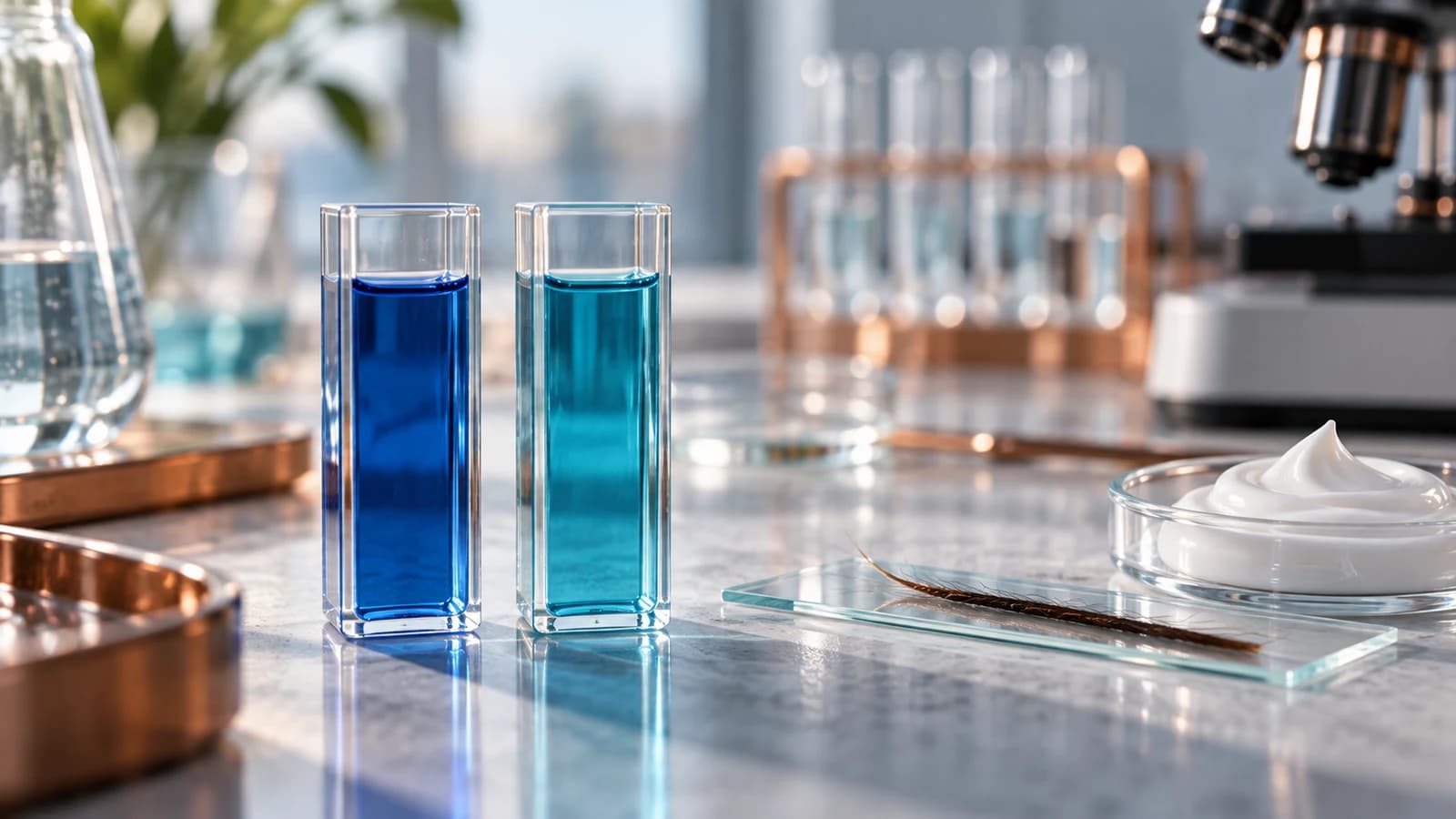
Copper-containing systems can be visibly blue, and that appearance makes copper peptides distinctive in product photography. Color alone, however, cannot distinguish GHK-Cu from AHK-Cu. Nor does it establish peptide content or rule out free copper and other species in the sample. A visually attractive sample still needs an analytical specification.
The relevant questions include the peptide identity, copper content, how the complex is defined, and which analytical methods support the offered material. A method that disrupts a complex during analysis may answer a different question from one that examines the intact solution under relevant conditions. The buyer should understand what each result actually measures rather than expect one test to resolve every aspect of coordination chemistry.
Separate three measurements
- Peptide identity: Which amino-acid sequence is present?
- Quantity: How much peptide and copper are assigned to the material?
- Solution behavior: Which properties are observed under the tested formulation conditions?
These measurements can be complementary. None should be silently substituted for another. In particular, a total copper result does not by itself establish that all copper is present in the desired complex, and a peptide purity result does not establish the complete copper-speciation picture.
For formulators, this is where an ingredient-specific specification becomes commercially valuable. It allows two samples to be compared on more than color intensity. If one product’s apparent strength comes from a different concentration or composition, the comparison should reveal that before the formulation trial is interpreted as a biological difference.
A deep-blue solution can be visually consistent with a copper-containing system, but it is not proof of sequence, purity, concentration, or a particular coordination state.
LaviPep inquiries should therefore request the actual offered GHK-Cu or AHK-Cu specification and the available supporting methods. Ask which independent measurements establish the ingredient's identity and content, and what each method can distinguish. Those answers determine which parts of the offered material can be compared reliably with another sample before formulation work begins.
6. Compatibility belongs to the full formulation
A copper-peptide ingredient does not remain isolated once it enters a serum, cream, or research medium. Other ingredients, pH, processing, packaging, and storage can affect the system. A generic compatibility chart can be a useful screening aid, but it should not claim that every ingredient pair behaves identically at every concentration and condition.
The practical approach is to identify likely interaction questions and test the actual formulation. Strongly binding constituents can change metal speciation. Conditions that alter peptide or complex stability can change the material over time. A finished formulation should therefore be evaluated as a system rather than approved because each individual ingredient has a favorable article.
Swipe or scroll to compare all columns.
| Formulation variable | Question to investigate | Useful evidence |
|---|---|---|
| pH and buffer | Does the intended system remain stable? | Defined-condition stability measurements |
| Other metal-binding ingredients | Is copper distribution or complex behavior altered? | Appropriate analytical comparison of the actual mixture |
| Oxidation and light exposure | Does composition change during storage? | Packaging- and condition-specific testing |
| Vehicle and processing | Does preparation affect solubility or distribution? | Reproducible manufacturing and sampling records |
| Container system | Does the product remain consistent through shelf life? | Finished-formulation and package evaluation |
Avoid turning a research concentration into a recipe
The experimental concentrations in the primary studies belong to their models.[1][2][3] They are not universal instructions for a consumer product, and they do not define how a formulation should be used with a procedure. In particular, compatibility with intact-skin cosmetics should not be assumed to establish suitability for application to disrupted skin or alongside microneedling.
A staged formulation plan can begin with identity and physical compatibility, continue through chemical stability, and then move to the appropriate performance and tolerability evaluation. The sequence helps identify a problem early, before a costly finished-product study is run on an unstable or poorly defined preparation.
For purchasing, request a pilot quantity that supports this sequence and a retained sample. If the ingredient presentation changes between pilot and scale-up, review the relevant formulation work rather than assuming the new form behaves identically because the peptide name stayed the same.
7. Ordering copper peptides for a real development program
A useful LaviPep inquiry starts with the exact ingredient: GHK-Cu, AHK-Cu, or both as separately defined materials. It should then identify the project category, desired presentation, pilot amount, likely repeat volume, and receiving country. This is enough to make the initial supply discussion specific without requiring disclosure of the complete formula.
If the project compares both ingredients, preserve separate lot records and preparation histories. Do not combine them at the outset unless the experiment specifically concerns a blend. Otherwise, a favorable or unfavorable result becomes difficult to attribute. The first comparison should make the difference between ingredients visible rather than hide it inside a complex formulation.
Commercial questions worth settling early
- Content basis: Are quotations expressed on comparable peptide or complex quantities?
- Presentation: Is the offered powder or solution suitable for the intended evaluation?
- Documentation: Which identity, copper, and stability information is available for the lot?
- Continuity: Can the accepted specification be maintained during repeat or bulk supply?
Price comparisons should include usable content, testing, packaging, and delivery scope. A cheaper sample that cannot be characterized or incorporated into the planned vehicle may create more work than it saves. Conversely, a well-defined pilot can prevent over-ordering by showing early whether the ingredient fits the project.
For OEM or private-label work, separate ingredient approval from artwork approval. A strong visual brand does not resolve a GHK-versus-AHK identity mismatch. The agreed specification should remain available beneath the commercial label, with lot traceability preserved through packaging and distribution.
Once the pilot is accepted, record the preparation method and acceptance criteria so that the next shipment can be evaluated consistently. If a lot changes, use a retained reference where appropriate. Those records give subsequent orders the same acceptance basis as the pilot. A changed lot can then be assessed against the retained reference and the agreed methods, instead of relying on its color or ingredient name.
8. The better copper peptide is the one matched to the question
GHK-Cu and AHK-Cu should be compared by identity, evidence, and intended application rather than by a universal ranking. The cited GHK-Cu studies concern collagen and connective-tissue measurements. The cited AHK-Cu study concerns human follicles and dermal papilla cells under experimental conditions.[1][2][3] Those differences are enough to guide a first research decision without pretending the studies establish equivalent finished-product outcomes.
For a hair-focused project, begin with the AHK-Cu evidence and define the endpoint that needs testing. For a matrix-focused GHK-Cu project, use the appropriate GHK-Cu sources. If the purpose is to compare both, design a shared experiment with clearly specified materials and controls. The shared copper-peptide category provides a reason to compare them, not permission to swap them silently.
A final pre-order check
Confirm that the article’s molecule, the laboratory’s protocol, the supplier’s specification, and the product label agree. Check that a blue appearance is not being used as the sole identity test. Keep ingredient evidence separate from finished-formulation claims. Then define the pilot quantity and the criteria for proceeding to a larger order.
LaviPep can discuss current supply options against that brief, including the form, amount, analytical support, and delivery requirements relevant to the project. A clear brief gives the sales conversation a productive destination: a sample and specification the buyer can actually evaluate.
Choose GHK-Cu or AHK-Cu by the specific skin or hair question. Verify the sequence and content, then test the actual formulation; neither a shared category nor a shared blue color establishes equivalence.
Explore the LaviPep product catalog, or return to the GHK-Cu research hub to follow this product's expanding evidence and supply guides.
Discuss your supply requirements
Samples & initial evaluation
Ask Lavipep about available specifications, evaluation quantities and batch documents before placing an initial order.
Discuss a trial orderBulk supply & private label
Send your product list, quantities, packaging needs and destination to discuss a commercial supply plan.
Discuss bulk supplyFrequently asked questions
What is the molecular difference between GHK-Cu and AHK-Cu?
GHK begins with glycine, while AHK begins with alanine. Both include histidine and lysine, but the different sequences require separate identity and evidence records.
Was the cited human hair-follicle study about GHK-Cu?
No. It investigated AHK-Cu in ex-vivo human follicles and cultured dermal papilla cells. It was not a clinical trial of a finished GHK-Cu scalp product.
Does a deep-blue color prove copper-peptide purity?
No. Color alone cannot establish the peptide sequence, concentration, purity, or complete copper-speciation picture. Appropriate analytical information is needed.
How can LaviPep support a formulation pilot?
Ask LaviPep about the available GHK-Cu or AHK-Cu form and its content and copper records. Include pilot quantity, repeat-supply needs, packaging, and destination. The actual formulation still needs stability and compatibility testing.
Scientific & technical references
- The effect of tripeptide-copper complex on human hair growth in vitro.
Archives of pharmacal research · 2007
Read via DOI · Read on PubMed - Stimulation of collagen synthesis in fibroblast cultures by the tripeptide-copper complex glycyl-L-histidyl-L-lysine-Cu2+.
FEBS letters · 1988
Read via DOI · Read on PubMed - In vivo stimulation of connective tissue accumulation by the tripeptide-copper complex glycyl-L-histidyl-L-lysine-Cu2+ in rat experimental wounds.
The Journal of clinical investigation · 1993
Read via DOI · Read on PubMed